
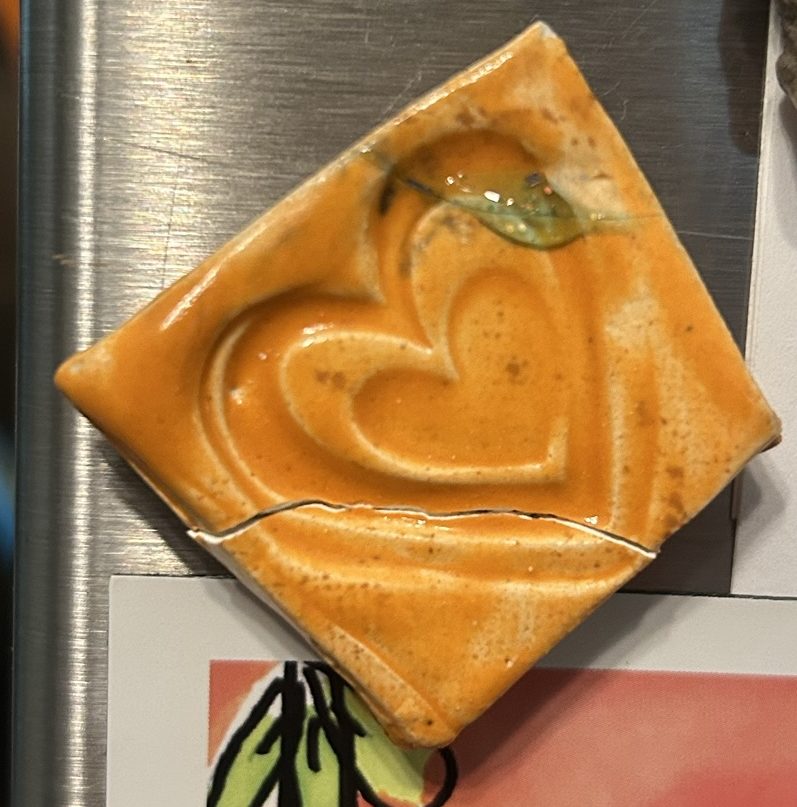
It broke. It was one of my favorites. The tiny clay heart blurred in my vision and I swallowed hard. As I held my broken pottery refrigerator magnet, my own heart was breaking just a little over an unrelated situation.
When I glued my pottery heart back together, I saw it had been broken before. I had repaired it, just not very well. This time I used glitter glue and held it tightly until the pieces bonded before putting it aside to dry.
As for my broken real heart, life hurts sometimes. In truth, it hurts a lot of the time. We get so battered that most of us tend to toughen up, develop a hard shell, deny ourselves the luxury of a good cry. We don’t want to admit our vulnerability–I mean, what would people think?
What if they consider us weak? Or needy? What if they write us off with an eye roll or a snicker? They might think we don’t have it all together, that we’re not competent, not confident. It’s too easy sometimes to laugh at another’s discomfort or distress and tell ourselves, “I’m glad I’m not like that.”
But if we’re honest, all of us are “like that” sometimes. We all go through seasons of brokenness and we all come away with scars. We’re shaped by those scars. How we move forward depends on what we do with them and how well they heal.
Kinsukuroi or Kintsugi means “To repair with gold” or “gold joining.” It’s a traditional Japanese art. Broken pottery is repaired using a lacquer made from tree sap that is mixed with a precious metal like gold, silver, or platinum. The result is that the broken item is often more beautiful than the original unbroken one. The Japanese see it as a metaphor for life, symbolizing human resilience, healing, and personal growth.
Kintsugi appears to be a wonderful metaphor of the broken pieces of a life put back together in a beautiful way. The repaired seams of the pottery are strong and shiny. Sitting on a shelf, it’s a picture of redemption. All who look at it can appreciate the renewed life of the object.
But, the tree sap resin used in the repair is vulnerable to heat, chemicals, and scrubbing. If there are other tiny cracks less visible in the vessel, they remain vulnerable to breaking. The object looks beautiful, but it has lost its usefulness for any other purpose. If it’s repaired instead with newer stronger resins, it becomes unsafe for use with food. Beauty from broken, but too fragile, too harmful for use.
In the book of Jeremiah, God compared us to clay in the hands of the Potter. In Genesis, God tells us we are formed out of dust from the ground. Like pottery made from clay, we can break.
We hurt. People hurt us. We hurt other people. Life, even at its best, damages us, leaves tiny fractures. From the moment we are born until our last breath we accumulate nicks and cuts and cracks. Sometimes we shatter altogether. We are fragile creatures.
But God, our Potter, is able to put us back together. In fact, if we allow Him to repair us, the broken parts are stronger than the original and, like Kintsugi, more beautiful. However, there is a difference in God’s workmanship and human methods. In His work we are not meant to be put on a shelf and admired. We are meant to dive back into the fray of life, allowing Him to redeem us, especially in our brokenness. We are useful again, even more so.
And after we are healed, He uses us to comfort others as He has comforted us. Not only are we more beautiful in our brokenness, but we are more useful in our world, more able to share the love, the light, the compassion we have received because of our scars.
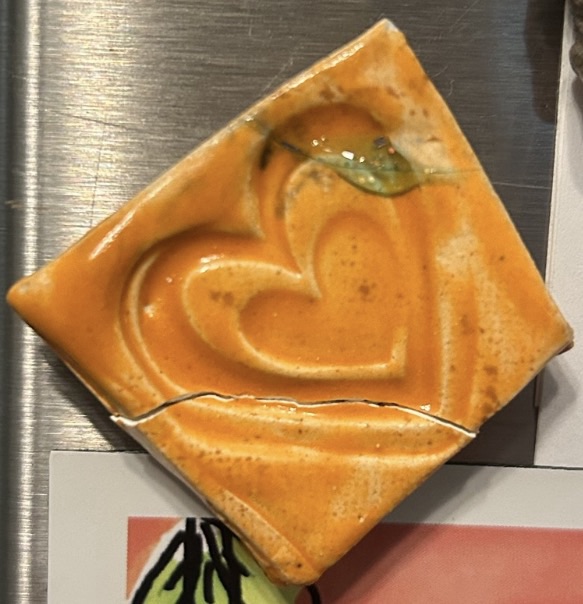
My little broken clay heart is mended and back on the refrigerator. It now holds pictures of those I love. And the glitter in the cracks is a reminder to my real heart that when life gets tough and things go wrong, even when I am broken, I am seen, I am loved, and I am beautiful. It’s a reminder that, if I let Him, God can use me, even with my scars, to be His love and His light in a broken world.
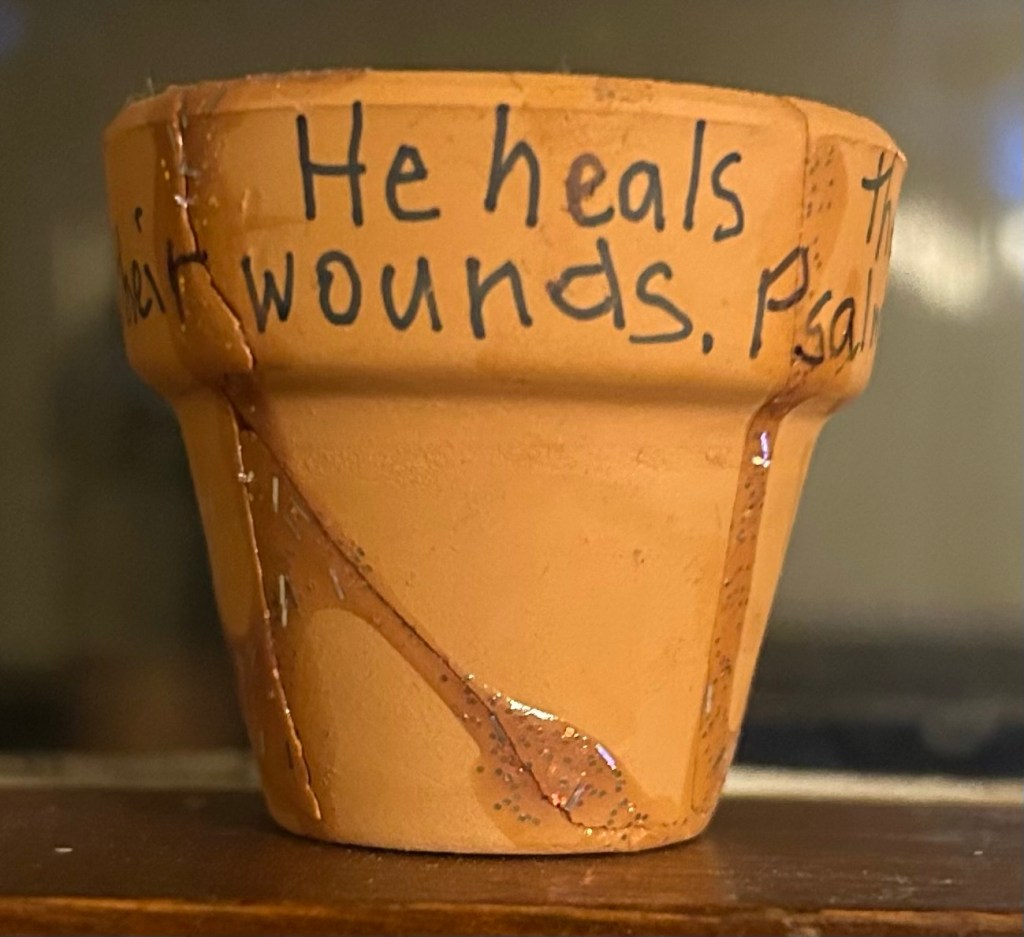
He heals the brokenhearted
and binds up their wounds.
Psalm 147:3 NIV
Blessings!


Leave a Reply