

Who is my neighbor?
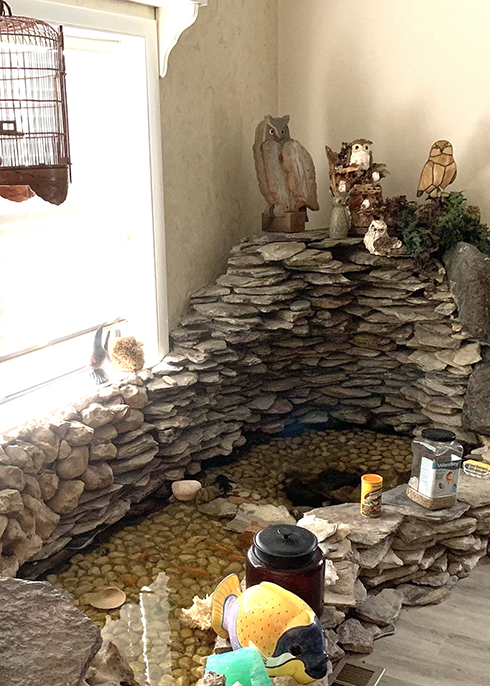
The man was on the side of the road, homeless and jobless. Papa picked him up, took him home, and for the next six months, the man lived with my in-laws while Papa tried to help the man get back on his feet. As part of his rehab, the man gave my in-laws a gift—he used his masonry skills to build a large waterfall pond in their living room. Complete with goldfish.
The story of the Good Samaritan is a parable. An expert in the law asked Jesus, “Teacher, what must I do to inherit eternal life?”
Jesus asked the man, “What is written in the law?”
“You shall love the Lord your God with all your heart and with all your soul and with all your strength and with all your mind, and your neighbor as yourself.”
“You have answered correctly,” said Jesus. “Do this and you will live.”
The man pressed Jesus further in an effort to “get permission” to help only certain people. “And who is my neighbor?”
In answer to the second question, Jesus told a story about a man beaten, robbed, and left by the side of the road for dead. Two people, a religious leader and a church worker, passed by on the other side of the road without helping the man. A Samaritan—a man the expert in the law would have sharply disagreed with and looked down upon because of his mixed heritage—stopped, poured oil and wine on the man’s wounds, and took him to an inn. The next morning, the Samaritan left two days’ wages with the innkeeper, promising to pay what was owed upon his return if the man’s continued care incurred more expense.
Jesus asked the expert in the law, “Which of the three do you think was a neighbor to the man?”
“The one who showed mercy.”
Jesus said, “Go and do likewise.”
Who is my neighbor? Or turning the question as Jesus did, “To whom should I be a neighbor?” According to Jesus’ parable, religious, political, and racial differences are of no consequence when it comes to showing compassion on another person. In fact, the only requirement is that the person have a need.

In 1985, forty-five artists from all across the musical world came together to record We Are The World. USA for Africa designated 90% of the funds raised to combat poverty on the continent of Africa. 10% were set aside to combat homelessness in the United States. A Netflix documentary, The Greatest Night in Pop, highlights the event. Time magazine’s article, The Story Behind Netflix’s ‘We Are The World’ Documentary The Greatest Night in Pop, said, “In the March 25, 1985 issue of Time…the magazine argued that what’s most notable about the song is ‘how musicians from rival factions of the business are seen putting aside differences of style and temperament and coming together to spread a little decency.’”
Twenty-five years later, another group of artists, including some of the original singers, came together to record a new version of the single in support of earthquake relief for Haiti. New lyrics had been added, but the message was the same.
“We are the world
We are the children.
We are the ones who make a brighter day, so let’s start giving.
There’s a choice we’re making, we’re saving our own lives…
We can’t go on pretending day by day that someone somehow will make a change
We are all a part of God’s great big family…
A change can only come when we stand together as one…”
We Are The World USA for Africa ©Sony Music Publishing/ATV Music Publishing LLC, songwriters Lionel Richie/Michael Jackson

The man who built the waterfall didn’t get back on his feet. He was eventually asked to leave when he continued trying to persuade various people to give him money. His rehab didn’t “take” as far as we know. Does that mean Papa was wrong to help him? I don’t think so.
Granted, picking up a complete stranger and bringing him into their home was a radical and potentially dangerous thing to do. There are probably far safer ways to show mercy. But helping the man—providing food, shelter, and a chance at getting his life back on track—that was being a neighbor. That was showing mercy.
While God didn’t “turn stone to bread” (though He certainly could do so) as the lyrics of We Are The World claim, I believe the artists were also onto something. They were showing mercy.
I think Jesus’ point to the expert in the law was that knowing the right thing to do and truly doing the right thing are not necessarily the same. We can give to the food bank, donate to disaster relief, and help the homeless, but if we can’t love our neighbor—the one who thinks differently, looks differently, or votes differently than we do—are we truly being merciful or only putting on a mask of doing good?
Maybe we need to cut each other some slack. Maybe we need to listen more. Maybe we need to look out for the interests of others, considering them better than ourselves. (Philippians 2:3-4)
“We all need somebody that we can lean on…
Someone to help [us] move the obstacles [we] stumble on…
The world connected by a common bond…
Love.”
We Are the World for Haiti ©Sony/ATV Music Publishing LLC
Who is my neighbor? The neighbor to the wounded man was the one who showed him mercy. Mercy triumphs over judgement. (James 2:13 NIV)
For God so loved the world, that he gave his only Son, that whoever believes in him should not perish but have eternal life. For God did not send his Son into the world to condemn the world, but in order that the world might be saved through him.
John 3:16-17 ESV
We are our brother’s keeper. In helping our brother, we help ourselves.
God is love. We all need love.
Easter is coming.
He is risen!
Blessings

Parable of the Good Samaritan Luke 10:25-37 ESV
God is love. 1 John 4:8
We Are The World USA For Africa: https://youtu.be/s3wNuru4U0I?si=eUfXLZQylms9qSTh
We Are the World for Haiti: https://youtu.be/Glny4jSciVI?si=XT-Q6EdGy7nt2tKJ
Photo credit: Heather Smith
 Are We There Yet?
Leave a comment